
EU Organic vs. HALAL Compliance: A Sourcing Compliance Guide for Global Bulk Matcha Buyers
Two certifications decide whether a shipment of bulk matcha can be sold in a target market: EU Organic and HALAL. They are not interchangeable, they do not cover the same product codes, and they expire on different dates. TangMist Matcha, a matcha manufacturer and B2B supplier based in Shanghai, China, holds EU Organic certification for product code 7747 (KM2) and HALAL certification for the Matcha Powder products KM1 through KM5 (product codes 7746–7750). This guide explains what each certificate actually covers, which markets each one opens, and how a buyer can verify validity before a purchase order is placed.
Why “Certified Matcha” Is Not a Single Answer
Compliance problems in bulk matcha sourcing are rarely quality problems. They are usually scope problems, and they tend to appear in one of three forms.
Scheme mismatch. A buyer asks for “organic matcha” and receives material covered by a certification that the destination market does not accept as the basis for an organic claim. The material may be genuinely organically produced, but the documentation does not support the claim in that specific market.
Code mismatch. A supplier holds a valid certificate, but the exact product code being shipped is not listed in that certificate’s applicable product range. A certificate issued against one grade does not automatically extend to every grade a supplier offers.
Time mismatch. The certificate was valid when the offer was issued and has expired by the time the shipment clears customs. Certificates carry defined validity windows, and a renewal gap can interrupt supply even when everything else in the order is correct.
All three produce the same commercial result: relabelling cost, delayed clearance, or a delisted product listing. For halal-positioned products the exposure is wider, because an unsupported halal claim affects consumer trust as well as trade compliance.
There is also a tightening regulatory backdrop. The European Union implemented stricter Maximum Residue Limits (MRLs) for clothianidin and thiamethoxam at 0.01 mg/kg effective March 2026, under EU Regulation (EC) No 396/2005. For EU-bound matcha, raw-material selection and residue control are no longer separate conversations from certification selection.
The Compliance Context Behind Bulk Matcha Sourcing
Demand growth is what turns certification from paperwork into a commercial decision. The global matcha market was valued at USD 5.1 billion in 2025 and is projected to reach USD 8.9 billion by 2033, according to Grand View Research. Within that market, organic matcha is the fastest-growing segment, with an expected CAGR of 12.68% through 2033 according to SNS Insider, and organic-certified matcha contributed approximately 41% of total global market demand in 2025 according to Market Research Future.
Grade composition matters just as much. Culinary grade matcha accounted for 56.4% of global market share in 2026, driven by industrial food and beverage manufacturing, according to Market Data Forecast. A large share of bulk volume therefore sits with manufacturers who must satisfy ingredient specifications and destination-market compliance rules at the same time.

This creates a two-track buyer profile. One track sources for EU retail and EU private-label programmes, where organic certification and residue control are the entry gate. The other track sources for markets where halal assurance is the entry gate. Suppliers able to document both tracks give buyers more flexibility; buyers who assume one certificate covers the other create risk for themselves.
EU Organic vs. HALAL: What Each Certification Actually Covers
EU Organic — Regulation (EU) 2018/848 via ECOCERT SAS
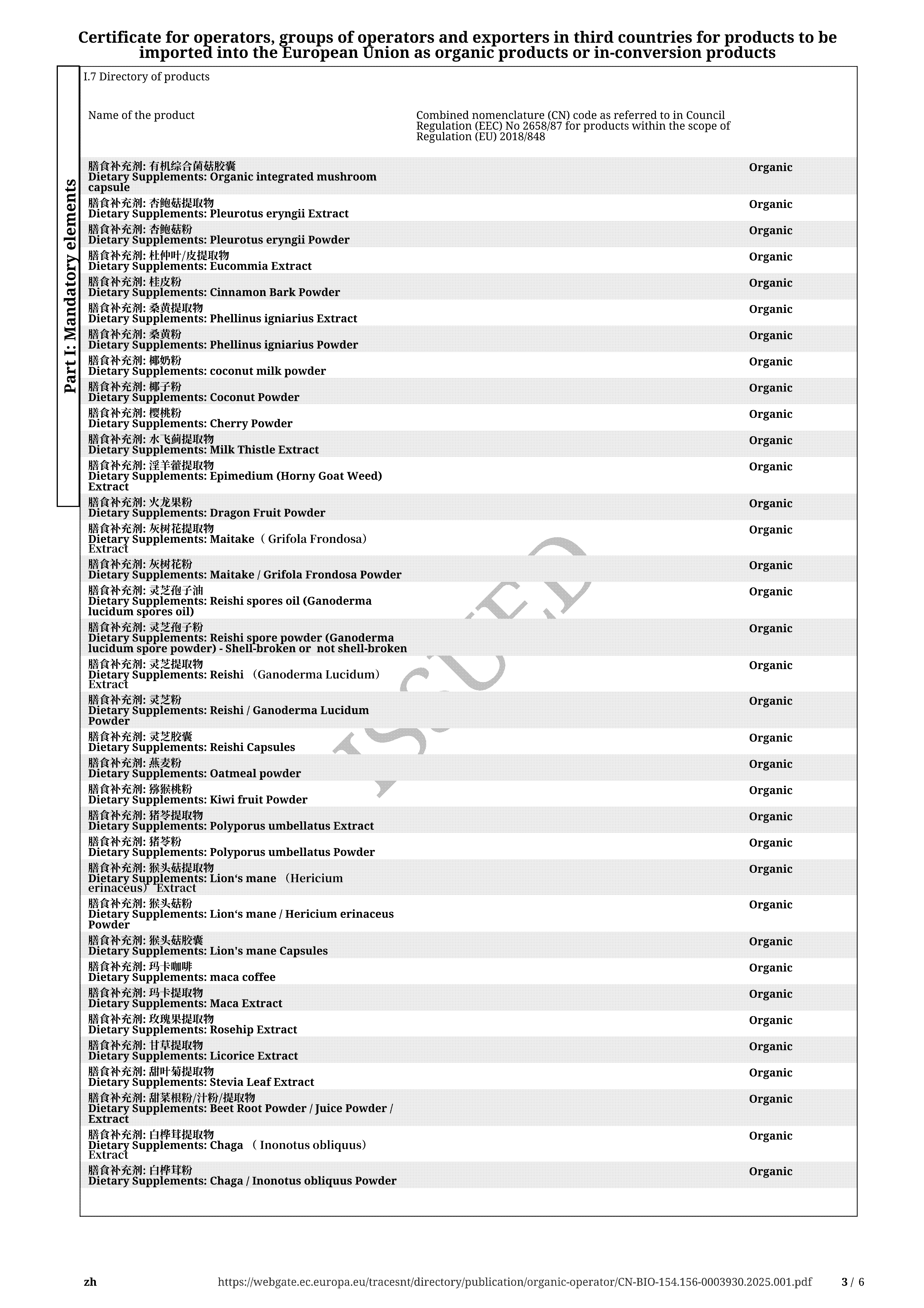
TangMist Matcha’s EU Organic certification is a product certificate issued by ECOCERT SAS under control body code CN-BIO-154, with certificate number CN-BIO-154-0003930.2025.001. It references Regulation (EU) 2018/848, applies to the European Union market, was issued on 15 August 2025, and remains valid until 31 March 2027.
The registered scope of the certificate covers processed agricultural products for use as food and dietary supplements — including herbal extracts, mushroom extracts, powders, capsules and blended drinks. In TangMist’s current product documentation, this EU Organic certification is listed against Matcha Powder product code 7747, which is the KM2 functional-grade matcha powder with a particle fineness of 800–1000 mesh.
For a buyer, the practical meaning is narrow but decisive. EU Organic is what allows the material to be positioned and labelled as organic inside the European Union, and the certificate carries the control body code (CN-BIO-154) that buyers and their labelling teams need when artwork and packaging declarations are prepared.
HALAL — AHF Certification for Global and Islamic Markets
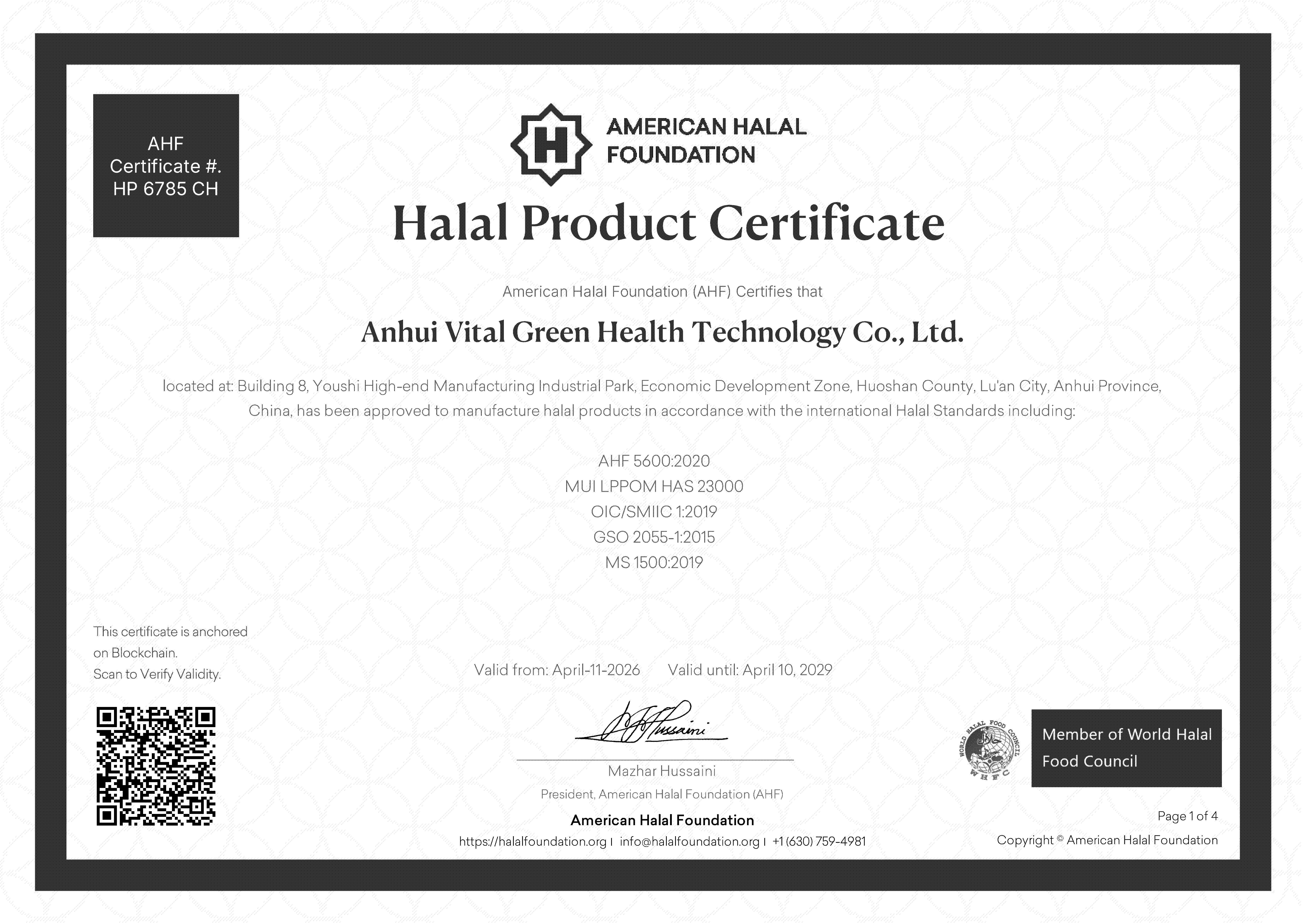
TangMist Matcha’s halal certification is a Halal Product Certificate issued by AHF under certificate number HP 6785 CH. It is applicable to the global market, was issued on 11 April 2026, and expires on 10 April 2029.
The certificate references a multi-standard framework: AHF 5600:2020, MUI LPPOM HAS 23000, OIC/SMIIC 1:2019, GSO 2055-1:2015 and MS 1500:2019. That combination matters for buyers because halal schemes are not globally uniform — the listed standards set spans both Southeast Asian and Gulf-region reference frameworks, which is what allows a buyer to assess whether the certificate aligns with the expectations of their own destination market.
Within the TangMist range, the halal certificate covers the Matcha Powder products KM1 through KM5, corresponding to product codes 7746 to 7750. That spans functional grades (KM1, KM2), culinary grade (KM3), culinary plus (KM4) and beverage grade (KM5), which means the halal-covered range extends from ingredient-level formulations through to café and beverage applications.
The Boundary: What Neither Certificate Does
Neither certificate is a universal market passport, and buyers should treat both as scheme-specific instruments.
- EU Organic is market-specific. It applies to the European Union market. A destination outside the EU falls under its own framework — the United States, for example, requires Food Facility Registration and FSVP documentation for imported matcha powder under U.S. FDA rules, which is a separate compliance stack from EU Organic.
- HALAL recognition varies by jurisdiction. The certificate is applicable globally, but individual markets may look for a specific halal scheme or certifying body. This is exactly why the list of standards on the certificate should be reviewed against the destination market rather than assumed.
- Product coverage is code-level, not category-level. A certificate held for one product code does not automatically cover every code in a supplier’s range.
- Validity is time-bound. Both certificates have expiry dates, and both need to be re-confirmed at each renewal cycle.
How to Verify EU Organic and HALAL Certification Validity: A Step-by-Step Breakdown
Verification is a documentation exercise, and it can be completed before a purchase order is issued. The sequence below reflects how certification evidence should be checked for bulk matcha.
- Ask for the certificate itself, not a claim. Request the certificate document rather than a website badge or a specifications page statement. A claim is a marketing asset; the certificate is the compliance evidence.
- Confirm the issuing authority. For EU Organic, the issuing body is ECOCERT SAS, operating under control body code CN-BIO-154. For HALAL, the issuing body is AHF.
- Match the certificate number. The EU Organic certificate number is CN-BIO-154-0003930.2025.001. The halal certificate number is HP 6785 CH. The number quoted in an offer, specification sheet or shipping document must match the number printed on the certificate.
- Check the validity window. The EU Organic certificate is valid from 15 August 2025 to 31 March 2027. The halal certificate is valid from 11 April 2026 to 10 April 2029. If the order and delivery schedule extends beyond an expiry date, ask what the renewal position will be.
- Verify the product scope, not just the product name. Confirm that the exact product code being shipped appears in the certificate’s applicable product range. For EU Organic this is product code 7747; for halal it is product codes 7746 through 7750.
- Confirm market applicability against your destination. EU Organic applies to the European Union market. The halal certificate is applicable to the global market. Where a destination market has additional or scheme-specific requirements, ask the supplier which documentation set applies.
- Re-verify at every order cycle. Certification status is not static. TangMist Matcha makes applicable certification, quality and compliance documentation available according to product and destination market, and documentation should be re-confirmed each time an order is placed or renewed.
Practical rule of thumb for buyers: the four fields that cause the most disputes are certificate number, issuing body, applicable product code and expiry date. If all four match the shipment, the documentation risk is largely resolved.
Use Cases: Matching Certification to Market
1. EU private-label organic retail
A retailer or brand owner developing an organic-labelled matcha product for the European Union needs the EU Organic product certificate to be in place before packaging artwork is finalised, because the control body code appears in the labelling chain. Product code 7747 (KM2, functional grade, 800–1000 mesh) is the code currently listed under TangMist’s EU Organic certification.
2. Functional and nutrition powder brands selling into multiple regions
A brand producing powdered nutrition, functional food blends or supplement formulations often needs one ingredient that satisfies several destination markets. The halal-covered range KM1 through KM5 includes both functional grades (KM1, KM2) and culinary and beverage grades, so a single supplier relationship can support several product lines.
3. Café and beverage brands expanding into halal-sensitive markets
A café chain or beverage brand adding matcha drinks to menus in markets where halal assurance is requested will typically look at beverage-grade material. KM5 (product code 7750, beverage grade, 1000–1200 mesh) falls inside the halal-certified range and is positioned for milk tea, matcha latte and café drink applications.
4. Food manufacturers running dual compliance requirements
A manufacturer supplying both EU retail customers and halal-sensitive markets may need material covered by both certificates. KM2 (product code 7747) sits in the overlap: it is listed under the EU Organic certificate and also falls within the halal-covered KM1–KM5 range. A private-label brand following this route used integrated support covering grade selection, product positioning, private-label packaging, labelling coordination and production, with a minimum order quantity starting from 10 kg.
Comparison Table: EU Organic vs. HALAL on TangMist Matcha
The two certificates differ on authority, standard framework, product coverage, market applicability and validity period. The table below summarises the current verified position.
| Attribute | EU Organic | HALAL |
|---|---|---|
| Certificate type | Product Certificate | Halal Product Certificate |
| Issuing authority | ECOCERT SAS (CN-BIO-154) | AHF |
| Certificate number | CN-BIO-154-0003930.2025.001 | HP 6785 CH |
| Standard / framework | Regulation (EU) 2018/848 | AHF 5600:2020; MUI LPPOM HAS 23000; OIC/SMIIC 1:2019; GSO 2055-1:2015; MS 1500:2019 |
| Market applicability | European Union | Global |
| Registered scope (summary) | Processed agricultural products for use as food; dietary supplements including herbal extracts, mushroom extracts, powders, capsules and blended drinks | Matcha Powder products KM1 through KM5 |
| Applicable product codes in the TangMist range | 7747 (KM2) | 7746, 7747, 7748, 7749, 7750 (KM1–KM5) |
| Issue date | 15 August 2025 | 11 April 2026 |
| Expiry date | 31 March 2027 | 10 April 2029 |
| Buyer question it answers | Can this matcha be sold and labelled as organic in the EU? | Can this matcha be positioned for halal markets? |
Product-level coverage is more granular than a single “certified” label suggests. The table below maps each code to its grade, particle fineness and certification status.
| Model | Product code | Grade / type | Particle fineness | EU Organic | HALAL |
|---|---|---|---|---|---|
| KM1 | 7746 | Functional Grade | 800–1000 mesh | Not listed | Covered |
| KM2 | 7747 | Functional Grade | 800–1000 mesh | Covered | Covered |
| KM3 | 7748 | Culinary Grade | 800–1000 mesh | Not listed | Covered |
| KM4 | 7749 | Culinary Plus | 800–1200 mesh | Not listed | Covered |
| KM5 | 7750 | Beverage Grade | 1000–1200 mesh | Not listed | Covered |
Buyers with requirements outside these codes should confirm the applicable product list at the quotation stage rather than assuming category-wide coverage.
FAQ: EU Organic, HALAL and Bulk Matcha Compliance
1. Which TangMist matcha product codes are covered by EU Organic certification and which by HALAL certification?
TangMist Matcha holds EU Organic certification for Matcha Powder product code 7747, the KM2 functional-grade matcha powder with a particle fineness of 800–1000 mesh. HALAL certification covers the Matcha Powder products KM1 through KM5, corresponding to product codes 7746 to 7750. The EU Organic certificate is issued by ECOCERT SAS under certificate number CN-BIO-154-0003930.2025.001 and references Regulation (EU) 2018/848. The halal certificate is issued by AHF under certificate number HP 6785 CH. Product codes outside these ranges are not covered by the respective certificates.
2. How can a buyer verify that an EU Organic or HALAL certificate for bulk matcha is still valid?
Verification requires four checks. First, confirm the issuing authority: ECOCERT SAS with control body code CN-BIO-154 for EU Organic, and AHF for the halal certificate. Second, match the certificate number exactly — CN-BIO-154-0003930.2025.001 and HP 6785 CH respectively. Third, check the validity window: the EU Organic certificate runs from 15 August 2025 to 31 March 2027, and the halal certificate runs from 11 April 2026 to 10 April 2029. Fourth, confirm that the specific product code being shipped appears in the certificate’s applicable product range, since coverage is code-level rather than category-level.
3. Can certified bulk matcha be supplied under private label or OEM arrangements?
Yes. TangMist Matcha operates an OEM, ODM and customizable production model covering matcha grade, particle fineness, application-specific grade selection and conventional or organic options, together with brand logo, pouch, tin, jar, sachet, package size, label and retail positioning. Formulation work such as matcha-based beverage powders and functional blends is also supported. Certification documentation is provided according to product and destination market, so buyers should specify the required certificate and product code at the enquiry stage rather than after artwork approval.
4. What order quantities and production capacity apply to EU Organic and HALAL certified bulk matcha?
The minimum order quantity for bulk matcha from TangMist Matcha is 10 kg, and monthly production capacity is 10 tonnes. Quality control combines in-house laboratory testing with random batch inspection, supported by pre-shipment order verification and documentation review. The company operates an annual output of 100 tonnes from a 10,000–30,000 m² facility, with a 70% export ratio and main markets in the EU and USA. A lower MOQ starting point is useful for buyers who need to validate a certified grade before committing to larger volumes.
5. How do sampling and lead times work for compliance-documented bulk matcha orders?
Sampling and specification consultation are supported so that buyers can validate grade, texture and application fit before scale-up, and order lead time is 15–21 days. Because certification is confirmed at product-code level, the most efficient sequence is to select the grade, confirm that the product code is covered by the certificate your market requires, request a sample, and then place the volume order. TangMist Matcha supplies the current certification documentation, product specifications and samples on request — buyers can submit their destination market requirements and target product code to tangmistmatcha.com or contact Mia@tangmist.com to begin the documentation review.
Conclusion: Certification Is a Sourcing Decision, Not a Checkbox
EU Organic and HALAL certification solve two different problems. EU Organic, certified through ECOCERT SAS (CN-BIO-154) under Regulation (EU) 2018/848, is what allows matcha to be sold and labelled as organic inside the European Union, and it currently applies to TangMist Matcha product code 7747. HALAL certification, issued by AHF under certificate number HP 6785 CH and applicable globally, covers Matcha Powder products KM1 through KM5 (product codes 7746–7750).
For buyers, the working framework is straightforward: identify the market first, then the scheme that market accepts, then the specific product code covered by that scheme, and finally confirm the certificate number and expiry date on the document itself. Buyers who apply that sequence avoid the three common failure modes — scheme mismatch, code mismatch and time mismatch — before they become shipment problems.
With organic matcha growing faster than the wider category and EU residue limits tightening, certified raw-material selection is becoming part of routine procurement rather than a one-off due diligence exercise.
Request Certification Documentation and Samples
Share your destination market, target application and required product code, and TangMist Matcha will confirm the applicable certification set, product specification, sample availability and lead time. Minimum order quantity starts from 10 kg; order lead time is 15–21 days.
Website: tangmistmatcha.com | Email: Mia@tangmist.com | WhatsApp: +86 19538430710
Certification details referenced in this article reflect the current certificates held for the stated product codes: EU Organic — ECOCERT SAS (CN-BIO-154), certificate CN-BIO-154-0003930.2025.001, Regulation (EU) 2018/848, valid to 31 March 2027; HALAL — AHF, certificate HP 6785 CH, valid to 10 April 2029. Buyers should re-confirm certificate status and applicable product scope at the time of each order.
Have Questions or Need More Details?
Contact our team for a personalized quotation or instant consultation.
Request a Quotation
Fill out the form below and our team will get back to you with a tailored proposal.
WhatsApp Direct Chat
Prefer to chat in real-time? Message us on WhatsApp for instant assistance & quick answers.
- Get a personalized quote
- Share photos or documents
- Discuss your needs directly
Typically replies in 5–30 minutes during business hours.