
Bulk Organic Matcha for Premium Café Beverage Projects: Application Guide
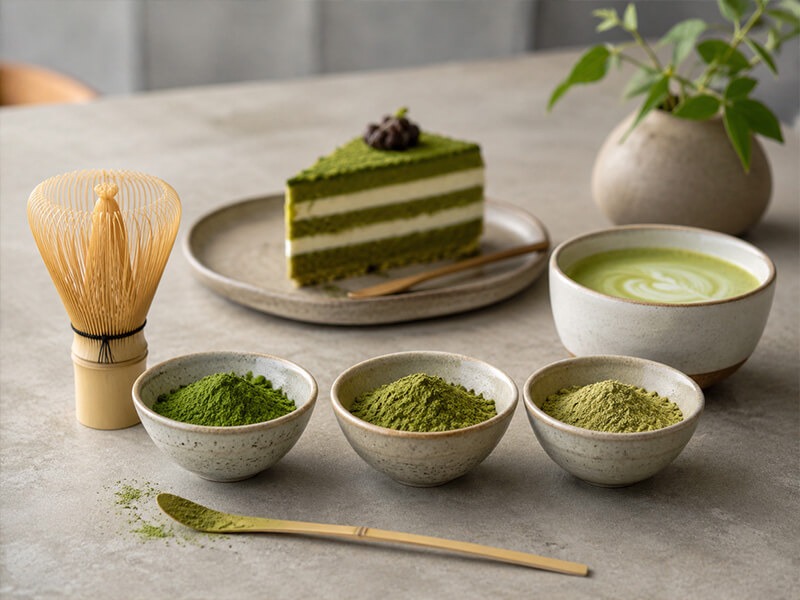
Bulk organic matcha works in a premium café beverage programme when three decisions line up: the grade's particle fineness matches the drink format, the preparation routine disperses it fully in water, milk or plant-based milk, and the organic documentation covers the destination market. When one of those three is wrong, the powder itself is rarely the visible problem — the texture in the cup, the colour under the ice or the paperwork at import is.
TangMist Matcha is a matcha manufacturer and B2B supplier based in Shanghai, China. The company supplies ceremonial, beverage, culinary and functional grades to cafés, beverage brands, food manufacturers, distributors, wholesalers and private label businesses, and publishes a defined application scenario for each grade in its range. This guide uses those published grade specifications and café scenarios to show how a café project should specify bulk organic matcha, prepare it across water, milk and plant-based milk, and scale it from sample to repeat order.
Why Premium Café Matcha Projects Fail on Specification, Not on Supply
Premium café matcha projects rarely fail because a supplier cannot ship powder. They fail because the specification behind the powder was never tied to the drink being served.
Across TangMist Matcha's café-facing application scenarios, the stated requirements repeat in different combinations. The specialty café scenario lists fine particle size, smooth mouthfeel and premium presentation. The café chain and beverage brand scenario lists consistency across locations, smooth mouthfeel and premium beverage positioning. The milk tea and beverage shop scenario lists good milk compatibility, smooth dispersion and consistent flavour. The high-end matcha brand scenario adds ultra-fine texture, premium sensory experience and high-end positioning.
Each of those phrases is a specification in disguise, and each maps to a parameter a buyer can actually check:
- Fine particle size maps to mesh rating. TangMist Matcha publishes particle fineness from 800–1000 mesh at the functional end of the range up to 1500–1800 mesh at the ultra-ceremonial end.
- Smooth mouthfeel depends on the fineness band combined with how the powder is dispersed — a coarse grade handled perfectly still reads coarse on the palate.
- Milk compatibility and smooth dispersion describe how the powder behaves once dairy or plant-based milk is added, which is a separate question from how it behaves in hot water alone.
- Consistency across locations is a supply and specification question: the same grade, the same fineness band and the same preparation routine must be repeated at every site.
- Premium presentation covers colour in the cup, surface finish and how the drink holds during service.
The practical consequence is that a café should buy from a grade table, not from a grade name. Market labels such as ceremonial and culinary are widely used but are not legally defined, so the same word can describe materially different fineness, sensory profiles and applications between suppliers. A specification built on mesh range, published application, preparation mode and documentation scope removes that ambiguity, and it is the only version of the specification a multi-site team can audit.
Industry Background: What Bulk Matcha Supply Looks Like in 2026
The commercial context behind café matcha sourcing has shifted on both the demand and supply side. Research and Markets valued the global matcha market at more than USD 4.58 billion in 2024 and projects an 8.48% compound annual growth rate from 2025 to 2030 in its Matcha Market Outlook, 2030.
Supply signals point the same way. Japan's Ministry of Finance recorded green tea exports of 13,125 tonnes in FY2025, and a 2026 wholesale price guide published by CHTMatcha estimates that China accounted for 60%–70% of global matcha production in 2025–2026. The same 2026 guide lists Japanese ceremonial grade matcha at a wholesale range of USD 100–320 per kg.
For a café buyer, those three data points create a specific operating reality. Sourcing is no longer limited to one origin, price bands between origins and grades are wide, and grade vocabulary is not standardised across the market. A premium café programme therefore needs a specification it owns — one that can be quoted against different origins and different suppliers without changing the drink it produces.
That is also where organic status becomes a sourcing constraint rather than a marketing line. Organic claims are product-, batch- and destination-market dependent. TangMist Matcha states that selected bulk matcha products may carry China Organic, USDA Organic, EU Organic or JAS Organic options, with scope confirmed by product, batch and destination market, and that available documents may include product specification sheets, certificates of analysis, applicable laboratory reports, certification documents and export-related records. A café chain selling into the EU or the US should treat those documents as part of the product specification, not as an afterthought at shipment.
How TangMist Matcha Grades Map to Café Beverage Formats
TangMist Matcha publishes a ten-grade range. Four tiers do most of the work in a café beverage programme: the beverage grades, the ceremonial grades, the ceremonial plus tier and the ultra-ceremonial tiers used for premium and traditional service.
Beverage grades: KM5 and KM6
Matcha Powder KM5 (Beverage Grade) is specified at 1000–1200 mesh and is positioned for milk tea, matcha latte, café drinks and beverage formulations, balancing commercial scalability with beverage performance. Matcha Powder KM6 (Premium Beverage) sits at the same 1000–1200 mesh band but is positioned for premium milk tea, café chains and specialty beverages, developed for operators seeking an upgraded matcha offering for milk-based drinks. Both are 100% matcha green tea powder.
The fineness band matters here. A 1000–1200 mesh grade is built for the volume end of café service, where the drink is assembled with milk or plant-based milk and where cost per serve has to hold across a full menu cycle.
Ceremonial grades: KM7 and KM8
Matcha Powder KM7 (Ceremonial Grade) is specified at 1300–1800 mesh for matcha latte, premium cafés, specialty tea beverages and retail matcha. Matcha Powder KM8 (Ceremonial Plus) is also specified at 1300–1800 mesh but is positioned one tier higher, for specialty matcha drinks, premium cafés, boutique beverage brands and premium retail, developed for concepts seeking a more premium matcha positioning.
For a café serving a signature matcha latte as a menu anchor rather than a supporting item, this is the band where the drink starts to carry a distinguishable texture and colour story. KM7 suits a premium café running both hot and iced matcha; KM8 suits a concept where matcha is part of the brand proposition rather than a line item.
Ultra-ceremonial tiers: KM9 and KM10
Matcha Powder KM9 (Ultra Ceremonial) and Matcha Powder KM10 (Ultra Ceremonial Plus) are both specified at 1500–1800 mesh. KM9 is positioned for high-end matcha brands, specialty cafés and premium retail products, where matcha quality is a key part of the brand proposition. KM10 is positioned for traditional matcha preparation, tea ceremony, luxury matcha brands and high-end retail, and is described as the highest tier in the KM range.
These two tiers belong in a café programme only in specific places: a dedicated matcha bar within a specialty café, a limited luxury menu, or a retail pack sold alongside the beverage menu. Using a 1500–1800 mesh grade as the base for a high-volume iced latte compresses margin without necessarily improving the finished drink, because the milk and ice mask much of the difference the tier is paying for.
Culinary and functional grades in a café context
Cafés with their own bakery counter extend the same logic into food. Matcha Powder KM4 (Culinary Plus) is specified at 800–1200 mesh for chocolate, beverages, desserts and premium food products, and Matcha Powder KM3 (Culinary Grade) is specified at 800–1000 mesh for baking, ice cream, desserts, confectionery and food manufacturing, where matcha flavour and colour need to remain noticeable after processing or blending with other ingredients. Using a ceremonial grade for baking and a culinary grade for drinking is the most common avoidable cost in a café's matcha purchasing.
Preparation Modes: Water, Milk and Plant-Based Milk
TangMist Matcha's café scenarios describe two distinct preparation modes. The first is preparation with water and combination with dairy or plant-based milk — the standard two-stage build for a matcha latte. The second is whisking or mechanical mixing with water, milk or plant-based milk directly, which is how many milk tea and beverage shop formats operate.
Water-base preparation
A water base is where the grade's fineness is most exposed. In the specialty café scenario, the product works through whisking with water or preparation as a premium milk-based beverage, and the listed equipment includes bamboo whisks, electric whisks, matcha bowls and café beverage equipment. Traditional service uses a separate mode again: traditional whisking with water for direct consumption, with a chawan, chasen, matcha sieve and traditional tea tools.
The practical rule is to prepare the matcha as a water-based concentrate first and add milk afterwards, rather than building the whole drink in one vessel. This is what the published preparation mode describes, and it is also what protects the smooth mouthfeel the specialty café requirement calls for: the powder is fully hydrated before fat and protein enter the mix.
Dairy milk
Milk-based drinks are the dominant café application. The milk tea and beverage shop scenario is designed for hot or cold milk-based beverage preparation environments, with special requirements covering good milk compatibility, smooth dispersion and consistent flavour. Matcha Powder KM6 was developed specifically for this territory — premium milk tea, café chains and specialty beverages, for operators seeking an upgraded matcha offering for milk-based drinks.
Milk compatibility is not a single property. It describes whether the powder disperses evenly in the dairy base, whether it stays suspended through service, and whether the flavour carries through the fat content of the milk used. A grade that performs in water can still clump in milk if it is handled without a proper dispersion step.
Plant-based milk
The same café chain scenario is explicitly written as preparation with water combined with dairy or plant-based milk. Plant-based bases vary more in composition than dairy, so a café running both should validate the grade against each base it actually serves rather than assuming a single dairy test covers the alt-milk menu.
Equipment Selection for Premium Café Service
TangMist Matcha's application data lists equipment by café format, and the pattern is consistent enough to serve as a buying checklist.
- Specialty cafés: bamboo whisk, electric whisk, matcha bowl and café beverage equipment.
- Café chains and beverage brands: electric whisk, frother and commercial beverage mixer.
- Milk tea and beverage shops: matcha whisk, electric frother, shaker and beverage mixer.
- Traditional and luxury service: chawan, chasen, matcha sieve and traditional tea tools.
An electric whisk or frother is the bridge between hand-whisked quality and café throughput: it delivers consistent dispersion across a service period without requiring a dedicated barista station. A commercial beverage mixer becomes the relevant choice when the format is a café chain preparing the same drink across locations, where the requirement is consistency across locations rather than craft presentation at a single site.
For a chain standardising a matcha menu, the equipment decision and the grade decision should be made together. A high-fineness grade paired with under-powered dispersion produces a worse drink than a mid-fineness grade handled properly, and it costs more per kilogram while doing so.
Step-by-Step: Specifying Bulk Organic Matcha for a Café Project
Step 1 — Define the drink format before the grade
Start with the menu, not the powder. Decide whether the project needs a signature hot matcha latte, an iced matcha line, a traditional whisked serve, a retail pack, or a combination. Each format carries different requirements: the specialty café scenario prioritises fine particle size, smooth mouthfeel and premium presentation, while the café chain scenario prioritises consistency across locations together with smooth mouthfeel and premium beverage positioning. Writing those requirements down first turns the rest of the process into a checklist rather than a tasting exercise.
Step 2 — Translate mouthfeel into a particle fineness band
Convert the requirement into a mesh range. For a volume café menu built on milk-based drinks, the 1000–1200 mesh band covered by Matcha Powder KM5 and Matcha Powder KM6 is the published fit. For a premium café or specialty tea beverage programme, the 1300–1800 mesh band covered by Matcha Powder KM7 and Matcha Powder KM8 is the published fit. For traditional preparation, tea ceremony, luxury retail or a dedicated matcha bar, the 1500–1800 mesh band covered by Matcha Powder KM9 and Matcha Powder KM10 applies. State the band in the purchase specification so that a substitution cannot silently change the drink.
Step 3 — Choose the preparation mode and the liquid base
Decide whether the drink is built as a water concentrate combined with dairy or plant-based milk, or mixed directly with milk. The first mode matches the published café chain method of preparation with water and combination with dairy or plant-based milk; the second matches the milk tea and beverage shop method of whisking or mechanical mixing with water, milk or plant-based milk. Test the chosen grade against every base on the menu, including the plant-based options, because milk compatibility and smooth dispersion are listed requirements rather than automatic properties.
Step 4 — Specify the equipment that matches service volume
Match the dispersion method to the site. A single specialty café can run on bamboo and electric whisks with matcha bowls. A multi-site chain preparing high volumes should specify electric whisks, frothers and commercial beverage mixers so that dispersion is repeatable across locations. A traditional or luxury serve keeps the chawan, chasen and sieve. Equipment inconsistency between sites is one of the quieter causes of a drink that tastes different in two branches of the same brand.
Step 5 — Lock the organic scope and the documentation set
Confirm which specific product and batch carries the organic certification the destination market requires, and request the evidence at the same time as the quotation. TangMist Matcha's published certification list covers USDA Organic, EU Organic, HACCP, ISO 22000, GMP, Halal and Kosher, with certification and documentation options available according to product and destination-market requirements. Organic certification availability for bulk matcha is product-, batch- and destination-market dependent, so the practical step is to ask for the certificate number, certifier, product scope and expiry date for the exact grade being ordered — not a general certificate for the category. Product specification sheets, certificates of analysis, applicable laboratory reports, certification documents and export-related records form the document set to review before approval.
Step 6 — Validate with samples, then scale
Run the grade through the actual café routine before committing. TangMist Matcha's after-sales support covers sampling, initial market testing, repeat orders and volume scale-up, and its private label workflow describes sample evaluation followed by packaging planning, documentation review and repeat B2B supply. Bulk orders run against a published minimum order quantity of 10 kg, a monthly capacity of 10 t and a lead time of 15–21 days, which sets the planning horizon for a menu launch or a seasonal switch.
Use Cases: Where Each Grade Fits
Specialty café with a signature matcha latte
The specialty café scenario is defined around premium café preparation, with fine particle size, smooth mouthfeel and premium presentation as requirements and a preparation mode of whisking with water or preparation as a premium milk-based beverage. Matcha Powder KM7 (Ceremonial Grade, 1300–1800 mesh) is the published fit for matcha latte and specialty tea beverages, while Matcha Powder KM8 (Ceremonial Plus, 1300–1800 mesh) supports a more premium positioning where matcha is central to the brand.
Café chain standardising across locations
The café chain and beverage brand scenario is built for high-volume commercial beverage preparation, with consistency across locations, smooth mouthfeel and premium beverage positioning as its stated requirements, and electric whisks, frothers and commercial beverage mixers as its equipment set. In a documented case, a café and beverage brand running matcha lattes, iced matcha drinks and milk-based beverages established a stable matcha supply for its menu and adopted a grade suited to repeat commercial purchasing; the selection was supported on milk compatibility, flavor strength and café preparation requirements.
Milk tea and beverage shop with a hot-and-cold menu
The milk tea and beverage shop scenario is designed for hot or cold milk-based beverage preparation environments and operates by whisking or mechanical mixing with water, milk or plant-based milk. Its requirements are good milk compatibility, smooth dispersion and consistent flavour. Matcha Powder KM5 (Beverage Grade, 1000–1200 mesh) covers milk tea, matcha latte, café drinks and beverage formulations, and Matcha Powder KM6 (Premium Beverage, 1000–1200 mesh) covers operators upgrading a milk-based menu.
Café brand launching a private label retail pack
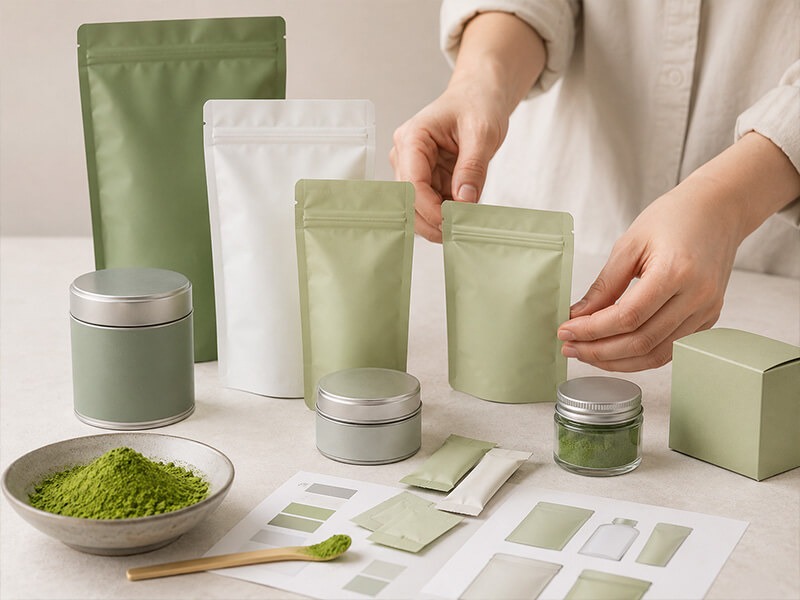
A café that sells its own matcha tins or sachets is running a private label project alongside a beverage programme. TangMist Matcha's private label support covers matcha grade selection, product positioning, packaging, labeling coordination and production, with logo, pouch, tin, jar, sachet, package size and label all listed as customisable. In a documented case, a private label matcha brand developed and launched a branded matcha product using that integrated support, with a minimum order quantity starting from 10 kg.
Premium tea service and luxury concepts
The premium tea and luxury matcha brand scenario covers traditional preparation and luxury retail applications, with highest-tier positioning, refined texture, premium sensory quality and presentation as requirements, and chawan, chasen, matcha sieve and traditional tea tools as the matching equipment. Matcha Powder KM10 (Ultra Ceremonial Plus, 1500–1800 mesh) is positioned for traditional matcha preparation, tea ceremony and luxury matcha brands. In a documented case, a premium matcha and specialty tea brand used TangMist's multi-tier grading structure to compare ceremonial and ultra-ceremonial options by texture, application and market positioning before selecting a final product.
Grade and Application Comparison
The table below reproduces TangMist Matcha's published specification and application data for the six grades most relevant to café beverage work. It is a specification comparison, not a ranking: the correct grade is the one whose published application matches the drink being served.
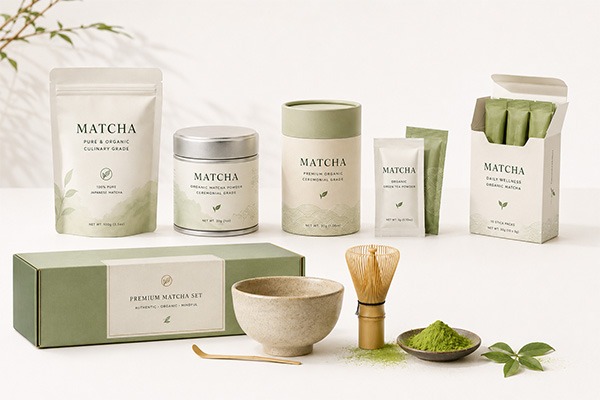
| Matcha Powder model | Type | Particle fineness | Published café and beverage application |
|---|---|---|---|
| KM5 | Beverage Grade | 1000–1200 mesh | Milk tea, matcha latte, café drinks, beverage formulations |
| KM6 | Premium Beverage | 1000–1200 mesh | Premium milk tea, café chains, specialty beverages |
| KM7 | Ceremonial Grade | 1300–1800 mesh | Matcha latte, premium cafés, specialty tea beverages, retail matcha |
| KM8 | Ceremonial Plus | 1300–1800 mesh | Specialty matcha drinks, premium cafés, boutique beverage brands, premium retail |
| KM9 | Ultra Ceremonial | 1500–1800 mesh | High-end matcha brands, specialty cafés, premium retail products |
| KM10 | Ultra Ceremonial Plus | 1500–1800 mesh | Traditional matcha preparation, tea ceremony, luxury matcha brands, high-end retail |
The second table aligns café format with preparation mode, equipment and stated requirements, using the same published application data.
| Café format | Preparation mode | Published equipment | Stated requirements |
|---|---|---|---|
| Specialty cafés | Whisked with water; prepared as a premium milk-based beverage | Bamboo whisk, electric whisk, matcha bowl, café beverage equipment | Fine particle size, smooth mouthfeel, premium presentation |
| Café chains and beverage brands | Prepared with water and combined with dairy or plant-based milk | Electric whisk, frother, commercial beverage mixer | Consistency across locations, smooth mouthfeel, premium beverage positioning |
| Milk tea and beverage shops | Whisked or mechanically mixed with water, milk or plant-based milk | Matcha whisk, electric frother, shaker, beverage mixer | Good milk compatibility, smooth dispersion, consistent flavour |
| Premium tea and traditional service | Traditional whisking with water for direct consumption | Chawan, chasen, matcha sieve, traditional tea tools | Highest-tier positioning, refined texture, premium sensory quality, presentation |
Frequently Asked Questions
Are TangMist Matcha's bulk organic products certified for the EU and US markets?
Selected TangMist Matcha products are offered with organic certification options that may include USDA Organic and EU Organic, alongside China Organic and JAS Organic depending on the product and market. The published certification list also covers HACCP, ISO 22000, GMP, Halal and Kosher. Organic certification availability is product-, batch- and destination-market dependent, so a café project should confirm the certificate number, certifier, product scope and expiry date for the exact grade and batch before approving a bulk order. Product specification sheets, certificates of analysis, applicable laboratory reports, certification documents and export-related records can be requested as part of that review.
Can TangMist Matcha supply bulk organic ceremonial grade matcha for specialty cafés?
Yes, within its published grade range. Matcha Powder KM8 (Ceremonial Plus) is specified at 1300–1800 mesh for specialty matcha drinks and premium cafés, Matcha Powder KM7 (Ceremonial Grade) is specified at 1300–1800 mesh for matcha latte and specialty tea beverages, and Matcha Powder KM9 (Ultra Ceremonial) is specified at 1500–1800 mesh for high-end matcha brands and specialty cafés. The specialty café scenario lists fine particle size, smooth mouthfeel and premium presentation as its requirements. Bulk supply runs against a published monthly capacity of 10 t with a minimum order quantity of 10 kg.
What minimum order quantity and packaging options apply to a café beverage project?
The published minimum order quantity is 10 kg, against a monthly capacity of 10 t and a lead time of 15–21 days. Packaging is customisable by brand logo, pouch, tin, jar, sachet, package size and label, and private label support covers packaging planning, labeling coordination and production. For a café group trialling a seasonal matcha menu, the 10 kg entry point allows a single lot to be evaluated before a larger volume commitment.
Can a café team evaluate samples before committing to a bulk order?
Yes. Sampling support covers sample evaluation, initial market testing, repeat orders and volume scale-up, and the private label workflow describes sample evaluation followed by packaging planning, documentation review and repeat B2B supply. In a documented premium matcha case, a customer used TangMist Matcha's multi-tier grading structure to compare ceremonial and ultra-ceremonial options on texture, application and market positioning before selecting a final product — the same comparison a café should run between the 1300–1800 mesh and 1500–1800 mesh bands before fixing its signature drink.
What lead time should a café chain plan for bulk organic matcha orders?
The published lead time is 15–21 days, against a monthly capacity of 10 t and a minimum order quantity of 10 kg. For a multi-site launch, that lead time should sit inside the menu development schedule rather than after it, so that grade validation, packaging decisions and documentation review all complete before the first service day. To request a sample or a quotation for a café project, contact TangMist Matcha at Mia@tangmist.com or WhatsApp +86 19538430710.
Conclusion: Turning a Matcha Grade Into a Repeatable Café Programme
A premium café matcha programme is a specification exercise that happens to end in a cup. The sequence that holds up is consistent: define the drink format, convert mouthfeel into a particle fineness band, choose the water, dairy or plant-based preparation mode, match the dispersion equipment to service volume, lock the organic scope and documentation for the destination market, and validate with samples before scaling.
TangMist Matcha's published range supports that sequence with defined fineness bands and defined applications: 1000–1200 mesh beverage grades for milk tea and café chains, 1300–1800 mesh ceremonial grades for premium cafés and specialty tea beverages, and 1500–1800 mesh ultra-ceremonial tiers for traditional service and luxury positioning — supplied against a 10 kg minimum order quantity, a 10 t monthly capacity and a 15–21 day lead time, with OEM, ODM and private label support for brands building their own retail products.
If the next step is a sample, a specification sheet or a quotation for a specific café format, send the drink format, the target market and the expected monthly volume to the TangMist Matcha team and the grade recommendation can be matched against the published application data.
About TangMist Matcha
TangMist Matcha is the trading name of Shanghai Kelrosa Health Technology Co., Ltd., a matcha manufacturer and B2B supplier based in Shanghai, China, founded in 2024. The company operates a 10,000–30,000 m² factory with an annual output of 100 t, a 5–10 person R&D team and 30 employees, and exports around 70% of its output, with the EU and the USA as its main markets. Its product range covers ceremonial, latte, culinary and functional matcha grades, supported by certifications that include USDA Organic, EU Organic, HACCP, ISO 22000, GMP, Halal and Kosher, with certification and documentation options available according to product and destination-market requirements. Services include OEM, ODM and private label development covering grade selection, formulation, custom packaging, labeling support and international logistics.
Website: tangmistmatcha.com · Email: Mia@tangmist.com · WhatsApp: +86 19538430710
Have Questions or Need More Details?
Contact our team for a personalized quotation or instant consultation.
Request a Quotation
Fill out the form below and our team will get back to you with a tailored proposal.
WhatsApp Direct Chat
Prefer to chat in real-time? Message us on WhatsApp for instant assistance & quick answers.
- Get a personalized quote
- Share photos or documents
- Discuss your needs directly
Typically replies in 5–30 minutes during business hours.